Contact Info
Emergency
9-1-1
Dispatch (Non-Emergency)
Inmate Information
PrisonerInfo@oaklandcountymi.gov
Inmate Property
General Information
Records Unit
ocsorecords@oaklandcountymi.gov

9-1-1
PrisonerInfo@oaklandcountymi.gov
ocsorecords@oaklandcountymi.gov
|
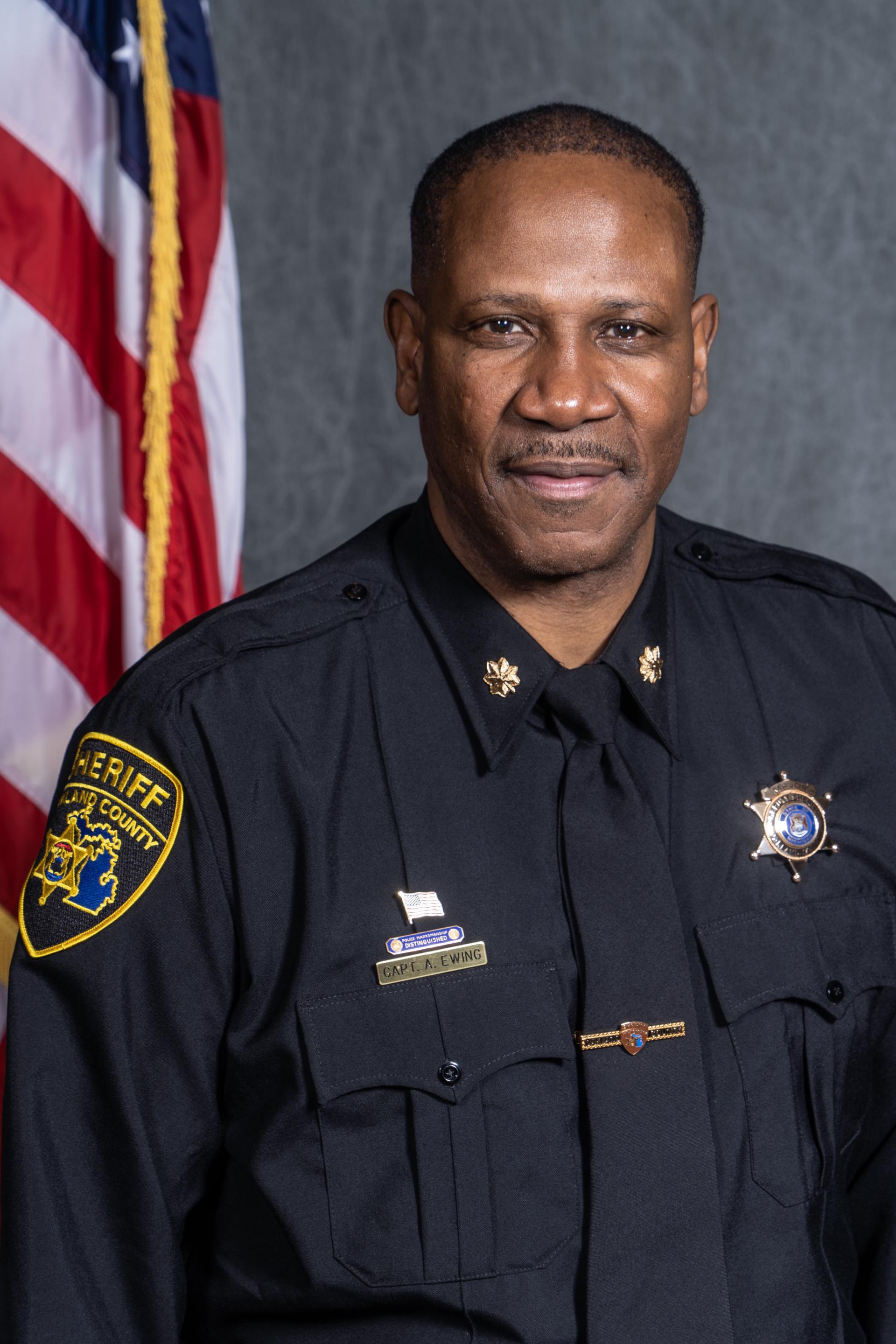
MAJORAndre EwingCommander | City of Pontiac Division |
Major Andre Ewing is the commander of the Sheriff's Office Pontiac substation. In his current role, Major Ewing is responsible for the day-to-day operations of the Pontiac substation.
Major Ewing was hired by the Sheriff's Office in 1987. He was promoted to the rank of Sergeant in 1999, to Lieutenant in 2012, Captain in 2018 and then promoted to Major in 2023. He has previously worked in Corrections, Road Patrol, Narcotics Enforcement and the Traffic Unit.
Major Ewing received his Bachelor of Arts Degree in 1984 from Louisiana Tech University, where he was a member of the Men's Varsity Basketball Team.
Major Ewing has been awarded citations for Community Service and Professional Excellence. In addition, he has received a Community Service Award from the World Egyptian Rite Masons.
Major Ewing was born and raised in the city of Pontiac, where he is widely remembered for his basketball prowess while a student at Pontiac Northern High School.
110 East Pike Street
Pontiac, Michigan 48342
Lobby Hours
24/7
Emergency: 911
Dispatch Non-Emergency: 248-858-4950
Substation Non-Emergency: 248-409-7100
Crime Tips: 1-888-TURN-1-IN
Fax: 248-409-7101
The Pontiac Patrol Division was created to provide contracted police services to the City of Pontiac. In addition to performing the conventional duties of law enforcement, the Sheriff's Office maintains a substation in the City of Pontiac, which is open 24 hours a day, affording residents the ability to:
You can get a copy of Traffic Crash reports from CLEMIS typically after 7-10 business days. You can get copies of all reports from the Sheriff's Office Records Division, located at 1201 N. Telegraph Road, Pontiac, MI 48341.
For information on obtaining a Personal Protection Order (PPO), visit our Personal Protection Orders page for a list of the different PPOs based on type of relationship.
Below is a list of links relating to a variety of traffic safety issues. In addition, the Oakland County Sheriff’s Office has numerous free publications that can be picked up at the substation. Deputies are also available to speak to various groups, business organizations and homeowners associations.
The Oakland county Sheriff's Office is dedicated to responding to traffic crashes and enforcing the Michigan Motor Vehicle Code.
If you have questions or concerns regarding traffic enforcement, contact the Pontiac Substation at 248-409-7100.
Publications are available at the substation, such as "Establishing Realistic Speed Limits," which address many of the concerns citizens usually have relating to speeding in residential areas and the use/placement of traffic control signs.
Several times during the year, enforcement is stepped up through Federal and State Grants. These enforcement efforts are publicized and include "Click it or Ticket," "Over the Limit. Under Arrest" and specific Red Light Enforcement grants.
The Oakland County Sheriff's Office Pontiac Substation, in partnership with the citizens of Pontiac, strives to build a free-flowing network of information to achieve the common goal of preventing crime, solving problems and making Pontiac a safe place to live.
Community Policing is a collaborative effort between the Sheriff's Office and the community that identifies problems of crime and disorder, and involves all elements of the community in the search for solutions. It is founded on close, mutually beneficial ties between deputies and community members. At the center of community policing are three essential and complementary core components:
Community Policing is a philosophy for effective law enforcement. Problem-solving employs tactics and strategies designed to address issues of crime and neighborhood decay. Partnerships are the tools or means with which positive problem-solving takes place.
The President's Commission on Criminal Justice in 1967 provided the framework for many of the changes to be found today in the criminal justice system. The crime rates in America during the 1960's had been gradually climbing, which prompted the government to investigate the status of the justice system and find ways to improve the functioning of the justice system. The Crime Commission's report conclusions stressed improvements in policing and community empowerments as a few of the strategies to reduce the overall crime rate.
Traditional methods of policing rely heavily on deterrence through a visible presence of the police on patrol. However, many social changes have occurred over the decades and traditional policing methods may not be as effective in addressing the needs of the communities. Communities have become more diverse and the problems have changed as drugs and violent crimes have become more prevalent in urban communities. Additionally, the budget deficits of the early 1990's prompted law enforcement administrators to seek out more creative solutions for providing law enforcements services to the community.
A program involving a joint effort between the Sheriff's Office and the community, designed to enhance neighborhood security, heighten the community's power of observation and encourage mutual assistance and concern among neighbors.
In recent years, neighborhoods have experienced rapid change. The old, well-established, tightly-knit neighborhoods have been replaced by growing communities where residents seek more privacy. Unfortunately, opportunities for criminal activity have increased, along with citizens' vulnerability to crime.
This condition creates a need for a crime prevention program which will enhance neighborhood security, heighten the communities' powers of observation and encourage mutual assistance and concern among neighbors.
The main objective of Neighborhood Watch is to reduce the incidence of crime by:
Please fill out the Neighborhood Watch Registration Form to register your association or update your associations' information. Forward the completed form to Sergeant Dooley (248-409-7108) at 110 E. Pike St., Pontiac, MI 48342 or fax it to 248-409-7101.
Yes. There is a $10 fee for each test.
No. This must be provided by the Michigan State Police. You can download and submit a written request at the Michigan Licensing and Regulatory Affairs page, or you can obtain an instant check by using their MSP ICHAT service.
No. Fingerprints must be taken at the Oakland County Sheriff's Office Records Department. For location, hours and fees, click on the "How Do I?" button at the top of this page, then click "Obtain Records."
Yes. For homes/businesses in the City of Pontiac only, there is a $5 fee for residential alarms and a $15 fee for commercial alarms. Do not use this form if your home or business is located outside the City of Pontiac. Please complete the Alarm Registration Form (located here and above under "Miscellaneous Forms"). The form is two pages; note the separate Commercial and Residential sections. Print the completed form and send with check or money order (payable to the City of Pontiac) to:
OCSO Pontiac Substation
ATTN: Alarm Compliance Officer
110 East Pike Street
Pontiac, MI 48342
If you have any questions, please contact the substation at 248-409-7109.
9-1-1
PrisonerInfo@oaklandcountymi.gov
ocsorecords@oaklandcountymi.gov