Contact Info
Emergency
9-1-1
Dispatch (Non-Emergency)
Inmate Information
PrisonerInfo@oaklandcountymi.gov
Inmate Property
General Information
Records Unit
ocsorecords@oaklandcountymi.gov

9-1-1
PrisonerInfo@oaklandcountymi.gov
ocsorecords@oaklandcountymi.gov
The forensic laboratory is accredited by the ANSI National Accreditation Board (ANAB) to
Oakland County Sheriff's Office Forensic Science Laboratory Current Certificate and Scope
The laboratory is committed to providing our clients with quality services. The laboratory understands the importance of timely, courteous, and professional service to meet our clients’ needs. We consistently strive to provide relevant, accurate, and thorough service using scientifically valid procedures under the direction of accreditation, statutory, and regulatory requirements.
Our mission is to provide our clients--the criminal justice system and individuals in the communities we serve--the highest quality forensic services. This mission is accomplished through the timely collection and examination of evidence using established methods and procedures resulting in clear and objective interpretations of analytical findings. Our staff is dedicated to the professionalism, integrity and ethics required to deliver reliable conclusions.
A Notice to Our Lab Customers: STRmix and Likelihood Ratios 2/16/2021
Administrator - Forensic Lab Services: Lori Bruski: 248-858-5019 | Email: ocsoforensiclab@oaklandcountymi.gov
Take our customer service survey!
The laboratory is composed of the following six sections: Crime Scene Processing, Biology/DNA, Drug Chemistry, Firearms/Toolmarks, Latent Print, and Toxicology. Analysts that work in those sections author reports detailing the results of the testing. They may be called upon to testify as an expert witness in a court of law regarding the results. Analysts also participate in the education of law enforcement personnel, training of new analysts, professional involvement in forensic organizations, and other community involvement.
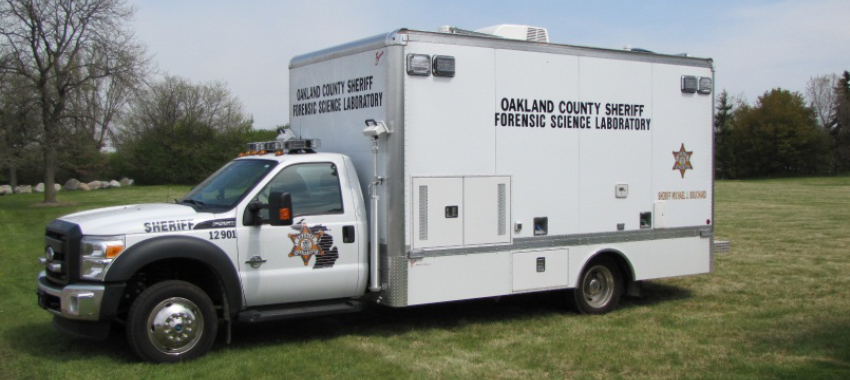
The laboratory operates a mobile crime unit that will respond to any crime scene, 24 hours, seven days a week. The Forensic Laboratory Specialists collect, preserve, and analyze evidence. The scene is documented with photographs, video, and crime scene sketches.
The Biology Unit of the laboratory examines items of evidence for the possible presence of biological fluids and materials, such as blood, semen, saliva, and skin cells. State of the art technologies and instrumentation are used to recover DNA from the biological sources. DNA is extracted from the biological fluids/materials, quantitated to determine the amount, and then amplified by making copies of the 24 locations that compose a DNA profile. Forensic DNA profiles developed from evidence items are compared to known DNA profiles associated with the cases in question.
Eligible evidence profiles are uploaded to the Local, State, and/or National databases of the Combined DNA Index System (CODIS). Profiles are electronically searched against other cases and known individuals, such as missing persons, convicted offenders, and arrestees in hopes of finding matches and aiding investigations.
The Drug Chemistry section of the laboratory analyzes samples submitted by various law enforcement agencies located in Oakland County and the surrounding areas. The section analyzes any substance seized in violation of laws regulating the sale, manufacture, distribution and use of controlled or illegal drugs. To perform this type of analysis, the laboratory must possess both a valid Controlled Substance Registration Certificate, issued by the Drug Enforcement Administration (DEA), and a valid license issued by the State of Michigan Board of Pharmacy.
The samples are tested to determine whether a controlled substance or an illegal drug is present. Various plant materials (e.g., marijuana, "spice"), powders (e.g., cocaine, heroin), crystalline materials (e.g., methamphetamine, MDMA, "bath salts"), tablets, capsules and liquids are tested daily at the lab. In addition, the lab provides a quick response to customer needs by applying testing protocols for new drug substances like synthetic marijuana and various designer drugs and by developing processing plans in relation to medical marijuana.
To assist in their testing, drug chemists employ state-of-the art analytical instrumentation in the laboratory. This provides broad testing capabilities for prescription drugs and illegal substances. Gas Chromatography/Mass Spectrometry (GC/MS) and Fourier Transform Infrared Spectroscopy (FTIR) help chemists by producing a spectral representation of a substance at its molecular level. Stereomicroscopic observations allow chemists to observe characteristics of marijuana plants too small to be seen by the unaided eye. Microcrystalline tests produce unique crystal structures when various drugs are exposed to chemical reagents such as platinic chloride or gold chloride.
The Firearms/Toolmarks section of the laboratory analyzes firearms ammunition components (fired bullets, fired cartridge cases) to attempt to identify if they were fired from a specific firearm. The barrel of a rifle or pistol contains spiral rifling called lands and grooves to increase the accuracy of a bullet. The rifling from the firearm is imparted onto the bullet as it travels down the barrel. These lands and groove impressions contain individual characteristics that can be identified and matched to a specific firearm. During the firing process, the firing pin, breach face, extractor, ejector and chamber of the firearm also leave individual characteristics on a fired cartridge case; these individual marks can be identified and matched to a specific firearm as well.
In addition to comparing ammunition components to firearms, firearms examiners conduct other examinations that include the following:
Examiners also utilizes NIBIN (National Integrated Ballistics Information Network) to link firearms and fired cartridge cases that may have been used in related crimes. NIBIN is a computer system that acquires and stores images of a fired cartridge case found at a crime scene or obtained from test firing a firearm. NIBIN looks for similarities between the images and ranks likely candidates for matches. The firearms examiner must confirm a match on a comparison microscope.
The Latent Print Unit of the laboratory conducts scientific examinations in friction ridge analysis. Friction ridge impressions can be left when a person touches an object with their hands or feet. The friction ridges that are invisible to the naked eye are called latent prints. Analysts process evidence to reveal the latent prints and locate any ridge structure present. The prints are preserved for future examinations.
Latent prints can be detected and developed using a variety of techniques such as chemicals, powders, lasers and alternate light sources. The use of the Full Spectrum Imaging System (FSIS) is also a method of viewing physical evidence for the presence of latent prints using short wave UV light prior to any type of chemical processing. This type of preprocessing can allow for additional testing for biological evidence without the evidence being compromised. Detected latent prints can be compared to the known impressions of an individual due to the uniqueness, permanence and arrangement of the friction ridges.
Latent prints can also be searched through a computer database. The Latent Print Unit operates on an Idemia AFIS (Automated Fingerprint Identification System). This system aids in the search for known finger and palm impressions which are then used in the comparisons and individualizations of latent ridge structure.
The Toxicology Unit performs drug and alcohol testing on biological specimens submitted to the laboratory. Blood specimens from OWI cases are tested for the presence of ethanol, also known as drinking alcohol. RESULTS Program urine specimens from court-ordered drug and alcohol testing are screened for the presence of various drugs and EtG (ethanol metabolite).
Blood specimens are analyzed with headspace gas chromatography with flame ionization and mass spectrometer detectors (HS-GC/FID/MS) to determine blood alcohol concentration (BAC). Ethanol is the intoxicating agent found in alcoholic beverages such as beer, wine and liquor. Any ethanol present in the blood sample is detected, identified, and quantitated using this instrumentation.
Urine specimens are analyzed with a Chemistry Analyzer utilizing immunoassay reagents to determine the presumptive presence of drugs and EtG. All specimens are also subjected to validity testing to ensure the sample has not been adulterated. The laboratory currently offers the following assays: amphetamines, benzodiazepines, cocaine, opiates, cannabinoids/marijuana, ketamine, buprenorphine, methadone, oxycodone, 6-acetylmorphine (heroin metabolite), fentanyl and EtG. Cut-off levels, to determine whether a sample is presumptively positive or negative for each specific assay, comply with the Michigan Association of Drug Court Professionals (MADCP) and/or the Substance Abuse and Mental Health Services Administration (SAMHSA).
9-1-1
PrisonerInfo@oaklandcountymi.gov
ocsorecords@oaklandcountymi.gov